

Dragee Almonds
Dragee Almonds
SKU:400000006895
Couldn't load pickup availability
DESCRIPTION
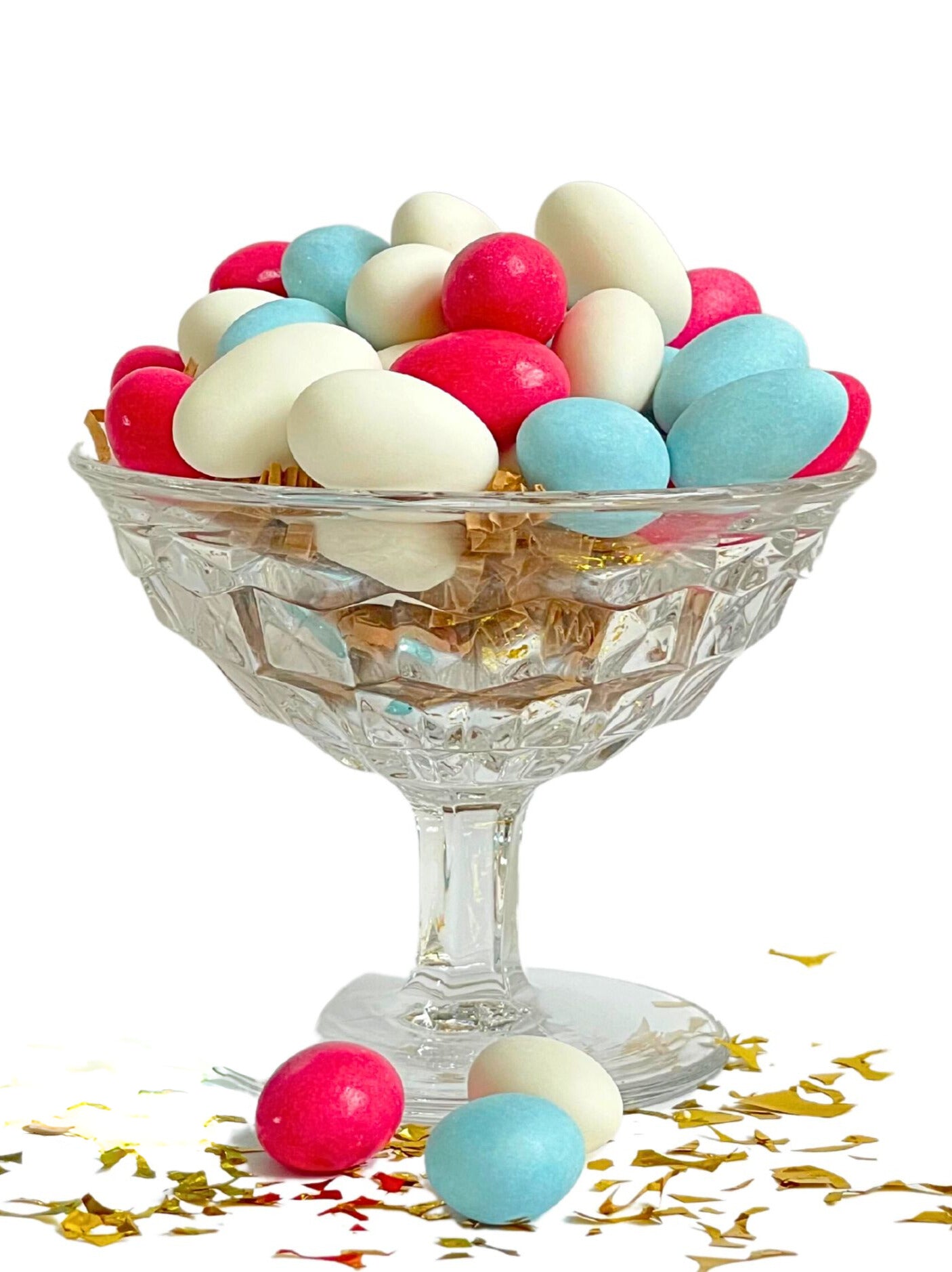
Our Jordan Almonds are different from what you usually find. The texture of the shell is smooth, almost creamy, but with the crunch you’d expect from other Jordan almonds. The colors are delightfully pastel, not as bright as you might find elsewhere. As for the flavor, rich and warm, superior to other Jordan almonds as they’re made by skilled craftsmen. And...a Great Gift as Jordan almonds are a symbol of good beginnings... perfect for Christmas, Easter, Wedding favors...you name it! Great with after dinner with coffee or tea. Traditionally shared with guests or enjoy when the fancy strikes you! Comes with an Easter card!
Product Details
Product Details
Size: 4 ounces in a 2x7" bag
Dragees: Sugar, Almonds, Wheat Flour, Dextrin, Corn Syrup, Artificial Flavors, FD&C Yellow Lake #5, Yellow Lake #6, Red #3, Red #40, Blue Lake #1, Blue Lake #2, Titanium Dioxide, Carnauba Wax, Confectioners Glaze.
Allergen Disclaimer: Please note that our products are made in a facility that processes peanuts, tree nuts, dairy, soy, and wheat. While we take precautions to prevent cross-contamination, we cannot guarantee that our products are allergen-free.
Historical Insights
Historical Insights
The practice of coating nuts and seeds in sugar has an extensive history. Unquestionably one of the favorites was the sugar-coated almond which played a ceremonial- if not culinary- role. At Roman weddings, for example, guests showered the bride and groom with mixed nuts, dried fruit, and confetto - honeyed almonds. So esteemed were the sugared almonds that in the fifteenth century, French queen Marguerite of Burgundy, arranged for her confectioner to make sugared almonds for the “common people” at the time of her wedding.
The reason for the Jordan almond’s esteem is deeply connected to the almond. In fact, the word “Jordan” originated not for the country but was derived from the Spanish word jardin, meaning garden. It was among the first trees to flower in spring, but was vulnerable to frost. So it came to symbolize new life and the possibilities and vulnerabilities of love. In the Bible, Aaron’s rod blossomed and produced almonds. The Romans threw almonds at weddings as a fertility charm.
Around the 17th century a process known as “panning” enabled widespread distribution of Joran almonds, not to mention other nuts, seeds, and fruits. At that time, confectioners coated the almond with gum Arabic in a “balancing pan” suspended over a large, low fire. There they rolled the seed or nut in sugar syrup. To keep the sugar coating even and the sugar from crystallizing, the confectioners had to keep the ingredients in constant motion, stirring with one hand and moving the pan with the other while controlling the temperature of the heat by controlling the intensity of the fire. Next, the confectioner let the candy dry for a day or two, then began the process again, adding layer upon layer over a period of weeks. They may have added food coloring, such as mulberry juice or cochineal for red, indigo stone for blue, spinach for green, and saffron for yellow.
The result was called “sugar plums.” “Sugar” for the ingredient and “plums” for the word meaning “good.” In other words, good sugar. Today, the process takes place in large, rotating drums with coatings that include chocolate.
Remarkably, the botanical-candy connection has eroded. Although we still enjoy fruit flavors and candies loaded with nuts, consumers, particularly in industrial societies, have no idea where the flavors come from. Licorice does not derive from an actual plant, but is an amorphous concept based on flavor. Anise, a less expensive substitute for licorice, is likewise a mystery to many licorice fans. The problem also lies in candy production itself. Today’s cinnamon is not from the bark of the cassia tree, but an industrial artificial flavor. The colors of strawberry hard candies and the predictably smooth veneer of chocolate have no resemblance of what exists in nature. But the legacy lives on.
Shipping
Shipping
📩 Check Your Email for the Tracking Number! 📩
📢 B2B orders may take longer to ship than estimated
Please allow 3-5 business days for processing new retail orders. Many of our products are hand-made and assembled, so some orders may experience some delays depending on availability. Most orders are shipped within 5 business days. If you have any questions or concerns about your order please reach out to us.

The practice of coating nuts and seeds in sugar has an extensive history. Unquestionably one of the favorites was the sugar-coated almond which played a ceremonial- if not culinary- role. At Roman weddings, for example, guests showered the bride and groom with mixed nuts, dried fruit, and confetto - honeyed almonds. So esteemed were the sugared almonds that in the fifteenth century, French queen Marguerite of Burgundy, arranged for her confectioner to make sugared almonds for the “common people” at the time of her wedding. The reason for the Jordan almond’s esteem is deeply connected to the almond. In fact, the word “Jordan” originated not for the country but was derived from the Spanish word jardin, meaning garden. It was among the first trees to flower in spring, but was vulnerable to frost. So it came to symbolize new life and the possibilities and vulnerabilities of love. In the Bible, Aaron’s rod blossomed and produced almonds. The Romans threw almonds at weddings as a fertility charm. Around the 17th century a process known as “panning” enabled widespread distribution of Joran almonds, not to mention other nuts, seeds, and fruits. At that time, confectioners coated the almond with gum Arabic in a “balancing pan” suspended over a large, low fire. There they rolled the seed or nut in sugar syrup. To keep the sugar coating even and the sugar from crystallizing, the confectioners had to keep the ingredients in constant motion, stirring with one hand and moving the pan with the other while controlling the temperature of the heat by controlling the intensity of the fire. Next, the confectioner let the candy dry for a day or two, then began the process again, adding layer upon layer over a period of weeks. They may have added food coloring, such as mulberry juice or cochineal for red, indigo stone for blue, spinach for green, and saffron for yellow. The result was called “sugar plums.” “Sugar” for the ingredient and “plums” for the word meaning “good.” In other words, good sugar. Today, the process takes place in large, rotating drums with coatings that include chocolate. Remarkably, the botanical-candy connection has eroded. Although we still enjoy fruit flavors and candies loaded with nuts, consumers, particularly in industrial societies, have no idea where the flavors come from. Licorice does not derive from an actual plant, but is an amorphous concept based on flavor. Anise, a less expensive substitute for licorice, is likewise a mystery to many licorice fans. The problem also lies in candy production itself. Today’s cinnamon is not from the bark of the cassia tree, but an industrial artificial flavor. The colors of strawberry hard candies and the predictably smooth veneer of chocolate have no resemblance of what exists in nature. But the legacy lives on.
The Sweet Journey Through Time Starts Here!
True Treats is the only historically accurate candy store in the world, bringing the past to life through researched sweets, teas, syrups, and more. Every product is rooted in history, telling the story of how people from all walks of life enjoyed treats through time. Leading this effort is Susan, a nationally recognized candy historian, researcher, and author who appears regularly on TV, radio, and in major publications. With over 40 years of experience, she has written ten books and founded True Treats to share the fascinating history of candy in a fun and delicious way. Susan’s work uncovers the surprising origins of America’s favorite sweets, from ancient uses of sugar to the candies of the 1900s. Through True Treats, Susan makes history an interactive experience, allowing customers to taste the past while learning the stories behind every bite.
Very tasty and fresh Jordan almonds.


