


Cotton Candy Drops
Cotton Candy Drops
SKU:
Couldn't load pickup availability
DESCRIPTION
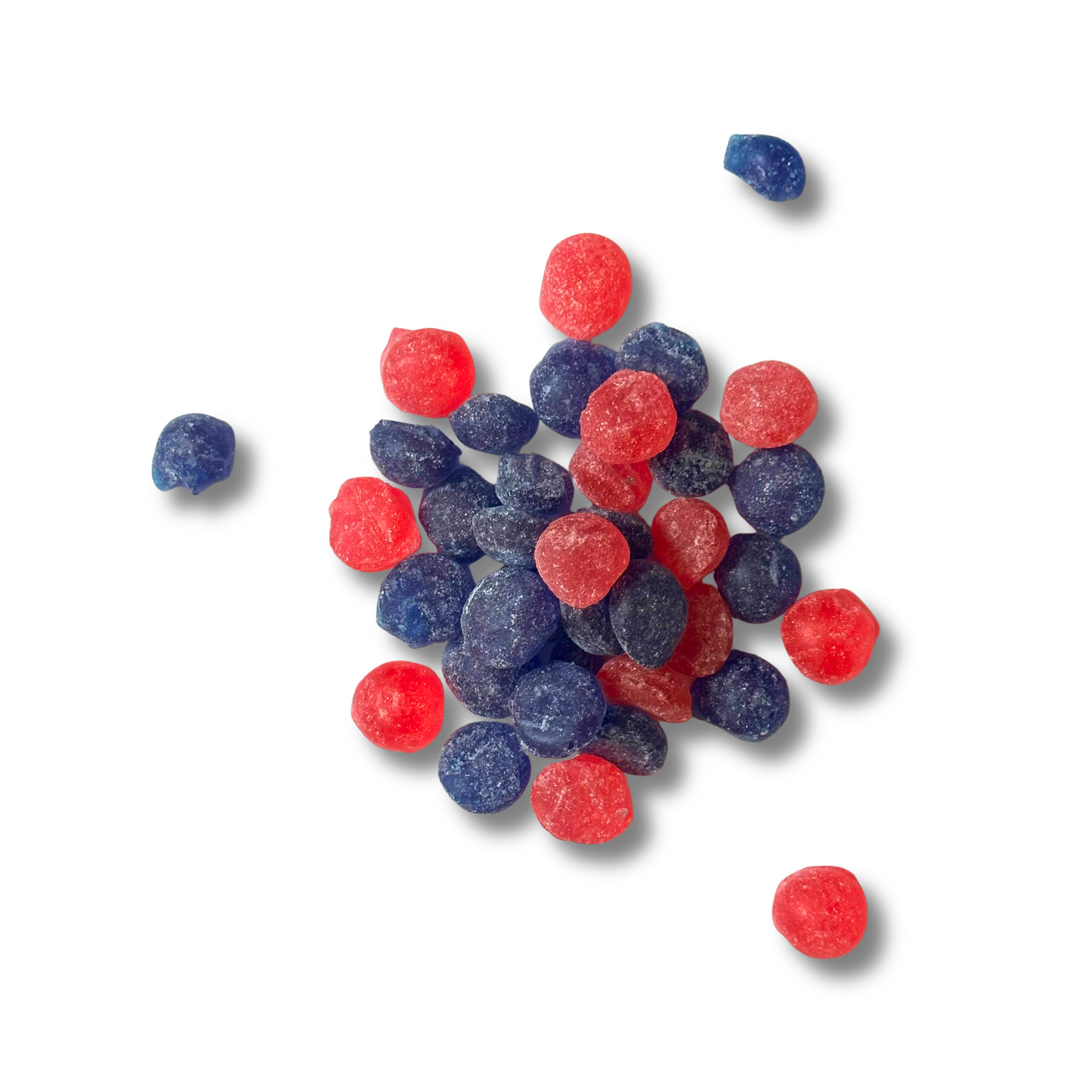
At long last! The wonderful and fun-filled flavor of cotton candy in a drop. Yes, now you can enjoy cotton candy wherever you go…. The melt-in-your mouth strands of sugar that dissolve even as you touch it held in a hard drop. The smooth cotton candy sweetness is still on your tongue as the hard candy slowly dissolves. And you’ll especially enjoy the subtle flavor of fruit called “blueberry flavor” or “raspberry flavor,” which tastes nothing like the real thing! All available in your purse or pocket, at home or at work, when you need a little something that can only be described as pure fun.
Product Details
Product Details
Allergen Disclaimer: Please note that our products are made in a facility that processes peanuts, tree nuts, dairy, soy, and wheat. While we take precautions to prevent cross-contamination, we cannot guarantee that our products are allergen-free.
Historical Insights
Historical Insights
Cotton Candy – The Story of Fun!
Sugar-based cotton candy demonstrates the history of candy in reverse. It started not as a medicine, like other candies, but as a fun food. Also known candy floss in Great Britain, fairy floss in Australia, la barbe à papa (Papa's beard) in France, and zucchero filato (sugar thread) in Italy, cotton candy was originally called “spun sugar.” The sweet was made in the 15th century by skilled pastry chefs in Venice who took sugary strands of spun sugar and wove them into elaborate designs, using a fork, broom handle and human ingenuity. The result was mainly for the well-to-do.
In 1769, Elizabeth Raffald, author of the The Experienced English Housekeeper offered readers a way "To spin a Silver Web for covering Sweetmeats” and in the 1840s, spun sugar baskets were advertised as an “ornamental confection” for the “nobility and gentry” and a sweet in England.
Cotton candy remained a hand-spun treat until the late 1800s when American candymaker John C. Wharton and his friend dentist, William Morrison, decided to popularize cotton candy by inventing a cotton candy-making machine. They introduced their creation at the St. Louis World's Fair in 1904. They doled out scoops in a wooden box to an eager public. Each serving cost 25-Cents, which was half the cost of an admission ticket. All told, Wharton and Morrison earned more than $17,000 in six months. Since then, cotton candy has found a place on boardwalks, carnivals and other festive events.
Cotton candy has, at last, found a place in the medical world, as well. Researchers at the New York–Presbyterian Hospital and Cornell University recently realized that cotton candy filaments mimic our bodies’ capillary systems. Since then, researchers have been using the cotton candy model to create synthetic flesh that could supply blood to damaged tissue. Or as the website Futurist put it: “Cotton Candy May be the Key to Creating Artificial Organs.”
Shipping
Shipping
📩 Check Your Email for the Tracking Number! 📩
📢 B2B orders may take longer to ship than estimated
Please allow 3-5 business days for processing new retail orders. Many of our products are hand-made and assembled, so some orders may experience some delays depending on availability. Most orders are shipped within 5 business days. If you have any questions or concerns about your order please reach out to us.


Cotton Candy: The Sweet Invention by a Dentist
Who knew – a dentist, William Morrison, invented cotton candy in 1897. He had teamed with a confectioner, John C. Wharton, to create a machine to spin sugar into what they called “Fairy Floss.” They announced the treat at the St. Louis World’s Fair in 1904, sold 68,000 boxes, and cotton candy rose to confectionery stardom! The pair went onto start a business called the “Electric Candy Company” which made machines people could use to make cotton candy at home. Little about cotton candy has changed today, except, of course, the name. That was created by Louisiana confectioner, Josef Lascaux – cotton reminded him of the cotton grown in the fields at home. Love Cotton Candy? Get more at our blog – from Susan’s newest book “Fun Foods of America.”
The Sweet Journey Through Time Starts Here!
True Treats is the only historically accurate candy store in the world, bringing the past to life through researched sweets, teas, syrups, and more. Every product is rooted in history, telling the story of how people from all walks of life enjoyed treats through time. Leading this effort is Susan, a nationally recognized candy historian, researcher, and author who appears regularly on TV, radio, and in major publications. With over 40 years of experience, she has written ten books and founded True Treats to share the fascinating history of candy in a fun and delicious way. Susan’s work uncovers the surprising origins of America’s favorite sweets, from ancient uses of sugar to the candies of the 1900s. Through True Treats, Susan makes history an interactive experience, allowing customers to taste the past while learning the stories behind every bite.


