


Civil War Commissary in a Box
Civil War Commissary in a Box
SKU:400000007465
Couldn't load pickup availability
DESCRIPTION
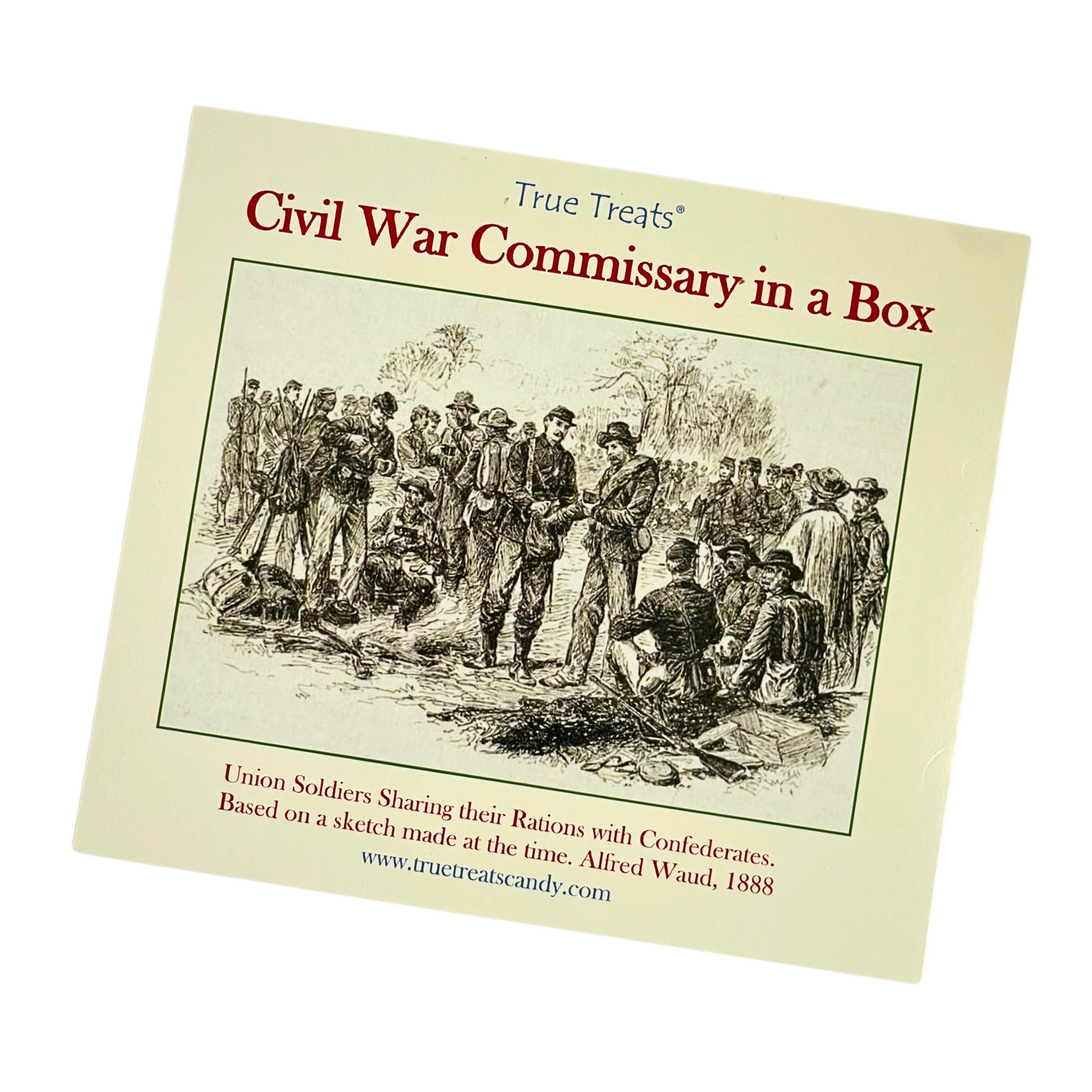
For the history lover! Experience the flavors and textures of Civil War era candy – such as stain glass, cacao beans, ginger, Turkish paste, dried cranberries, eating coffee and molasses pulls – 12 samples in all, with a keepsake card describing the purpose of each item. Some were considered medicines. Some were considered treats. Some were sent in packages from home, and others given to them by the army or government agencies. And don't forget - the front of the card contains a sketch of Union soldiers sharing food with their Confederate counterparts, drawn by renowned publisher and illustrator Frank Leslie, who chronicled the Civil War as it happened. Exclusive to True Treats!
Product Details
Product Details
Size: 12 different samples in a 5 15/16" x 1" x 7 3/4" box
Lemon Drop (Sugar, Glucose Syrup, dextrose, citric Acid, natural lemon flavor, yellow #5),White Sugar (cane sugar), Stain Glass (Sugar, Corn Syrup, Flavor, FD&C Colors. Jelly Beans (Sugar, Corn Syrup, Cornstarch, Modified Cornstarch, Maltodextrin, FD&C Red 40, Yellow 6, Yellow 5, Titanium Dioxide, Blue 1, Red 3, Natural and Artificial Flavors, Carnauba Wax, Beeswax, Confectioner's Glaze.), Molasses Pulls (Corn Syrup, Sugar, Milk, Vegetable Oils and Fats, Molasses.), Bugs (Crickets and Mealworms) Cranberries (Dehydrated Cranberries), Cacao Beans (Organic Cacao Beans Packaged in the same facility as peanuts, tree nuts, soy, and milk products), Coffee (organic Ethiopian Coffee). Amber Beet Sugar (Raw beet sugar), Ginger (Organic Ginger, Organic Raw Cane Sugar). Necco Wafers (Sugar, Corn Syrup, Gelatin , Natural & Artificial Flavors, Vegetable Gums (Gum Tragacanth Arabic & Xanthan), Chocolate , Citric Acid, Fd & Colors Yellow 5& 6, Blue 1, Red 3, and Red 40)
Allergen Disclaimer: Please note that our products are made in a facility that processes peanuts, tree nuts, dairy, soy, and wheat. While we take precautions to prevent cross-contamination, we cannot guarantee that our products are allergen-free.
Historical Insights
Historical Insights
Civil War soldiers did eat sugars and sweets - for many, they proved a vital part of their survival. Some were used as medicine. Others as a welcome break from other foods. Some soldiers made favorites for themselves at the start of the war, such as molasses pulls, made by one Confederate soldier in what he thought would be a short and decisive war. Hospitals and other organizations sent packages, many items such as cacao and sugar, recommended by the new US Sanitary Commission.
Where did Civil War Soldiers Get Sugars and Sweets?
Civil War soldiers got sugars and sweets from numerous sources. Early in the war plantations, where sugar cane was grown and produced by enslaved laborers, closed down. Instead, people used sugar made from a special “sugar beet” and sorghum grain. Abolitionists had used both of these alternatives before the Civil War as part of their boycott of foods made by slaves. By the end of the war, even these sugars, and so many other foods, were hard to find!
At the very early stages of the war, some soldiers made favorites for themselves – in a letter, one Confederate soldier describes making molasses pulls in what he thought would be a quick, decisive war. Here are some other sources of sugar and sweets:
Government
The government provided sweets, such as sugar cubes, at the onstart of the war, and continued in various iterations, as possible. Figures such as Ulysses Grant, for example, shipped large quantities of cranberries, rich in sugar and vitamin C, to Union troops at the Battle of St. Petersburg.
Sutlers
Soldiers with enough money, most usually Union soldiers, bought goods from sutlers - traveling groceries, often in make-shift tents, that followed the troops and sold raisins, citrus fruit, molasses candy, crystalized ginger, fruit and sugar. The sutlers were disreputable and their goods overpriced, but they did they did offer soldiers alternatives to the sparse wartime rations. The sutlers were later replaced by commissaries, providing approved goods at a reasonable cost.
Organizations
Hospitals and other organizations sent packages with such items as cacao beans and sugar, both considered healthy and medicinal. Many of these items were recommended by the new United States Sanitary Commission. Started in 1861, their goal was to educate staff at field hospitals and advise the public on healthy foods and shipping methods when sending packages to the troops. In 1862, for example, they recommended dried fruits and berries of all kinds, jellies and cocoa.
Others, such as the Maine Camp and Hospital Association sent clothing and medical supplies as well as marmalade, dried apples, tamarinds, black pepper, cayenne pepper, cocoa, strawberries in a jar, figs, candy, lozenges, peppermint, and tea. Still other items would have included dried berries and ginger snaps.
Shipping
Shipping
📩 Check Your Email for the Tracking Number! 📩
📢 B2B orders may take longer to ship than estimated
Please allow 3-5 business days for processing new retail orders. Many of our products are hand-made and assembled, so some orders may experience some delays depending on availability. Most orders are shipped within 5 business days. If you have any questions or concerns about your order please reach out to us.


Sugar, Medicine, and Morale: Civil War Era Candy, 1800s Candy, and Sweets in the Civil War
Civil War soldiers did eat sugars and sweets - for many, they proved a vital part of their survival. Some were used as medicine. Others as a welcome break from other foods. Some soldiers made favorites for themselves at the start of the war, such as molasses pulls, made by one Confederate soldier in what he thought would be a short and decisive war. Hospitals and other organizations sent packages, many items such as cacao and sugar, recommended by the new US Sanitary Commission. Where did Civil War Soldiers Get Sugars and Sweets? Civil War soldiers got sugars and sweets from numerous sources. Early in the war plantations, where sugar cane was grown and produced by enslaved laborers, closed down. Instead, people used sugar made from a special “sugar beet” and sorghum grain. Abolitionists had used both of these alternatives before the Civil War as part of their boycott of foods made by slaves. By the end of the war, even these sugars, and so many other foods, were hard to find! At the very early stages of the war, some soldiers made favorites for themselves – in a letter, one Confederate soldier describes making molasses pulls in what he thought would be a quick, decisive war. Here are some other sources of sugar and sweets: Government The government provided sweets, such as sugar cubes, at the onstart of the war, and continued in various iterations, as possible. Figures such as Ulysses Grant, for example, shipped large quantities of cranberries, rich in sugar and vitamin C, to Union troops at the Battle of St. Petersburg. Sutlers Soldiers with enough money, most usually Union soldiers, bought goods from sutlers - traveling groceries, often in make-shift tents, that followed the troops and sold raisins, citrus fruit, molasses candy, crystalized ginger, fruit and sugar. The sutlers were disreputable and their goods overpriced, but they did they did offer soldiers alternatives to the sparse wartime rations. The sutlers were later replaced by commissaries, providing approved goods at a reasonable cost. Organizations Hospitals and other organizations sent packages with such items as cacao beans and sugar, both considered healthy and medicinal. Many of these items were recommended by the new United States Sanitary Commission. Started in 1861, their goal was to educate staff at field hospitals and advise the public on healthy foods and shipping methods when sending packages to the troops. In 1862, for example, they recommended dried fruits and berries of all kinds, jellies and cocoa. Others, such as the Maine Camp and Hospital Association sent clothing and medical supplies as well as marmalade, dried apples, tamarinds, black pepper, cayenne pepper, cocoa, strawberries in a jar, figs, candy, lozenges, peppermint, and tea. Still other items would have included dried berries and ginger snaps.
The Sweet Journey Through Time Starts Here!
True Treats is the only historically accurate candy store in the world, bringing the past to life through researched sweets, teas, syrups, and more. Every product is rooted in history, telling the story of how people from all walks of life enjoyed treats through time. Leading this effort is Susan, a nationally recognized candy historian, researcher, and author who appears regularly on TV, radio, and in major publications. With over 40 years of experience, she has written ten books and founded True Treats to share the fascinating history of candy in a fun and delicious way. Susan’s work uncovers the surprising origins of America’s favorite sweets, from ancient uses of sugar to the candies of the 1900s. Through True Treats, Susan makes history an interactive experience, allowing customers to taste the past while learning the stories behind every bite.
The candy was a gift so, I was a bit shocked when I got a text that said there were worms and crickets in the box. I got embarrassed and asked if they were still alive? Got a second LOL text stating they were part of the ingredients, we laughed it off and I told them to please save those pieces for me. They were at one time Civil War re-enactors and C.W.buffs. Gene has passed, so his wife and sister in law thoroughly enjoyed the candies and memories. Thank-you!
My in-laws enjoyed the treats and we're surprised to learn the history of some of the candies. We had no idea some were as old as the Civil War. What was shipped as exactly as pictured!
I just finished teaching about the Civil War. This was a fun and educational way to finish the lessons. It arrived quickly and was good quality. It includes an explanation about the treats and the soldiers that enjoyed them. I would definitely recommend this product!
The candy arrived on time and was securely packaged. I know the names of three civil war soldiers in my family, and it was fun to taste what they might have eaten. All the candy was fresh, and some of it was really an eye opener. I have recommended this candy to others.
These are great. You get a nice selection of each candy, and it's fun eating what your gr.gr. grandfather ate.


