
Molasses Drops
Molasses Drops
SKU:
Couldn't load pickup availability
DESCRIPTION
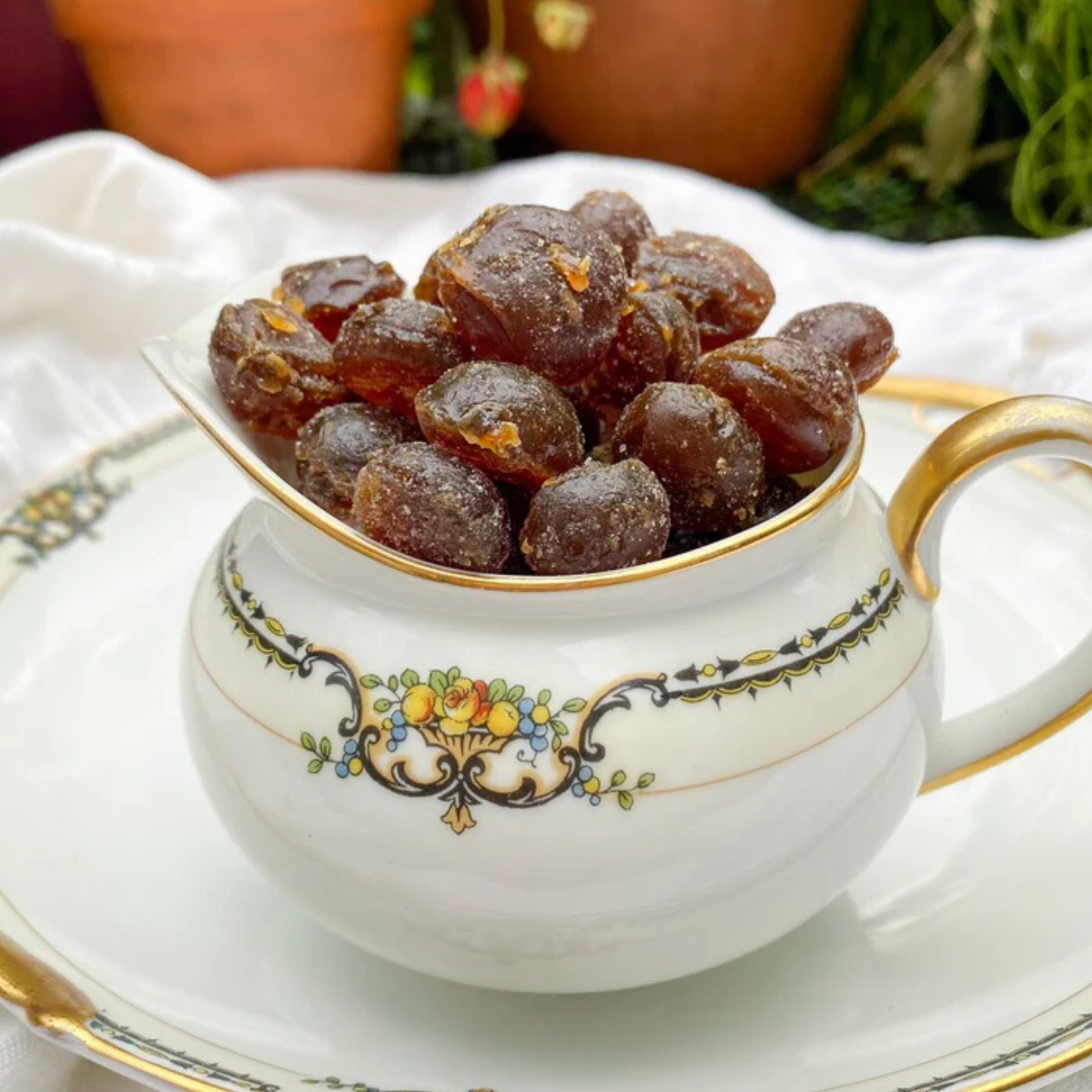
A sweet, rich-tasting candy drop, made in small batches from a family kitchen. The flavor is rich, and ever-so-slightly burnt, much like the coated on traditional Cracker Jacks, giving it a pleasant, nostalgic flavor. Each piece is “sanded” meaning it is lightly coated with sugar, so the pieces don’t stick. Perfect for refreshments, as a tasty breath freshener, and a must-have on trips. Truly unique!
Product Details
Product Details
Size: 4 ounces in a 3x6" bag
Sugar, Corn Syrup and Molasses.
Allergen Disclaimer: Please note that our products are made in a facility that processes peanuts, tree nuts, dairy, soy, and wheat. While we take precautions to prevent cross-contamination, we cannot guarantee that our products are allergen-free.
Historical Insights
Historical Insights
From Susan’s Award-Winning Book “Sweet as Sin”
Throughout the eighteenth, nineteenth, and early twentieth centuries, molasses was one of America’s most conflicted foods whose identity was shaped by whoever was eating it. It appeared in desserts, candy, biscuits and gingerbread, made hot and delicious in rural kitchens throughout the nineteenth and twentieth centuries. It was also a cheap, unwelcome substitute for nourishing foods, for slaves, prisoners, and the poor.
African Americans of the south, including those working in Thomas Jefferson’s Monticello before and after the Civil War, lived on bread, molasses and fat,[i] a diet that left them malnourished. Prisoners, who ate it as a steady diet, loathed it to the point that several prisoners, according to an article in a 1908 Topeka newspaper, went on strike, refusing to go to the “rock pile” with only bread and molasses for breakfast. These prisoners were then served bread and water each morning until they “gratefully returned” to molasses.[ii]
Later, in 1912, one Congressman underscored the desperate lives of strikers in Lawrence Massachusetts, saying: “It has been testified that these striking people have to put molasses on their bread because their wages are not sufficient to purchase butter.”[iii]
If molasses was controversial as a food, it was most definitely enjoyed as a candy. One of the early, pre-Civil War favorites was molasses pulls, among the few luxuries that enslaved people enjoyed on the plantations. In an interview with former slaves through the Depression era Federal Writer’s Project, Josephine Hamilton, who was enslaved in Arkansas, recounted: “At Christmas time, we had…cake, molasses candy that you pulled, horse apples that was good, better ‘n any apples we get these days.”[iv]
Lucky Civil War soldiers may have received pulled molasses in packages from home and definitely pulled the molasses themselves. Early on, confederate soldier John S. Jackman, wrote in his diary: “Pleasant day for winter. We are living well. Have good fresh beef, good pork, flour, sorghum, rice and so on, issued in abundance. We make the molasses into candy, have candy-pullings among ourselves.”
The pull soldiers and enslaved people mentioned were like taffy. On the battlefield and plantation, they may have flavored them with whatever was available, as the early molasses was bitter. In the confectionery, with the addition of vanilla, sugar, or spice, the pulls were literally pulled by hand or pulled from a hook. The book The Art of Confection, written by J.E. Tilton in 1865, reveals other molasses treats still with today:
“Candy of various kinds is made from molasses, such as stick molasses candy, pulled candy, taffy…The sticks may be single, twisted, braided flattened. Almonds, peanuts, hickory-nuts, &c, are often stirred into molasses candy which is also flavored with different essences, according to taste,” [v]
The late 1800s ushered in a new phenomenon to the candy world: the pull party. At these parties, young, European American couples, well-dressed and well-to-do, would pull the candy with lightly buttered fingers. The activity was recommended many years later, in 1964, in Boys Life, a magazine for boy scouts. The author has a beautiful description:
“It was great fun to watch the bubbling pan of hot liquid and to taste it when it was “tested” in a cup of cold water. The most fun, though, was pulling it. As you worked air into the candy it became lighter and lighter. When it cooled, the pulling became harder and harder. Soon it was a thick twisted rope that could be broken into bite-size pieces to hold in the back of your mouth or under your tongue as it melted.”[vi]
The molasses pull is also known as the molasses “taffy” or “toffee.” Many toffees today are still made with molasses and nuts, as described in the Civil War-era recipe. The toffee may have originated in England, where a favorite was the Everton Toffee made in the late 1700s.[vii] The words “taffy” and “toffee” are often intertwined, so the difference is this: toffee is harder and chewier, typically with nuts. The American toffee took off in the early 1900s through Prohibition, with such delicious molasses treasures as the Mary Jane and the Squirrel Nut Zipper, the style of candy Tilton was referring to in 1865.
By the 1940s, with machinery and industrial production a given, new candies were popping up everywhere, with colors and smells that defy the imagination. Oddly, a popular new molasses candy was straight forward and simple: the sponge candy, also known as sea foam. You’re likely to sample these crunchy bits in such places as upstate New York, Vermont and Massachusetts, but only from October to around February because of its sensitivity to humidity.
There’s the naked version which looks like molten chunks of brick of various sizes, with a bubbly center. The texture is amazing: they melt in your mouth, shrinking down to a mere reminder of their original size in seconds. Other versions are bite-sized and enrobed in chocolate. The texture inside looks almost like honey-comb, crisp, yellow and ribbed, and a delicious contrast to the smooth, chocolate texture outside.
[i] Deborah Jean Warner, “Sweet Stuff,” p. 33
[ii] “Prisoners refuse to go on rock pile on bread and ‘yup,” Topeka Daily Capital, October 13, 1908, p. 3.
[iii] Washington Times, “Witnesses Describing Striking Conditions in Lawernce,” March 7, 1912, p. 1
[iv] Slave Narratives, A Foilk History of of Slavery in the United States with Interviews with Former Slaves, (Library of Congress, Work Projects Administration) p. 133 and 136
[v] Janet Clarkson, The Food History Almanac: Over 1,300 Years of World Culinary History, Culture, and Social Influence, (Lanham, Maryland: Rowman & Littlefield, 2013), p.1247.
[vi] Billie Spencer, “An Old-Fashion Taffy Pull,” Boys’ Life magazine,July 1964,p. 63.
[vii] Laura Mason, Toffee, in The Oxford Companion to Sugars and Sweets, ed. Darra Goldstein (Oxford: Oxford University Press, 2015), p. 738.
Shipping
Shipping
📩 Check Your Email for the Tracking Number! 📩
📢 B2B orders may take longer to ship than estimated
Please allow 3-5 business days for processing new retail orders. Many of our products are hand-made and assembled, so some orders may experience some delays depending on availability. Most orders are shipped within 5 business days. If you have any questions or concerns about your order please reach out to us.
The Sweet Journey Through Time Starts Here!
True Treats is the only historically accurate candy store in the world, bringing the past to life through researched sweets, teas, syrups, and more. Every product is rooted in history, telling the story of how people from all walks of life enjoyed treats through time. Leading this effort is Susan, a nationally recognized candy historian, researcher, and author who appears regularly on TV, radio, and in major publications. With over 40 years of experience, she has written ten books and founded True Treats to share the fascinating history of candy in a fun and delicious way. Susan’s work uncovers the surprising origins of America’s favorite sweets, from ancient uses of sugar to the candies of the 1900s. Through True Treats, Susan makes history an interactive experience, allowing customers to taste the past while learning the stories behind every bite.


